

Lessons from America’s Largest Protest
By Jeremy Brecher, Senior Strategic Advisor, LNS Co-Founder

Half-a-century ago, tens of millions of households mobilized a nationwide meat boycott to challenge soaring food prices. It was arguably the largest protest in American history. Today, as a majority of Americans stress out over food prices and other signs of an “affordability crisis,” Donald Trump is running scared in the face of consumer rage. This commentary and the next ask how can ordinary grocery shoppers organize — and become part of the movement that is endeavoring to protect society against Trump’s authoritarian juggernaut?
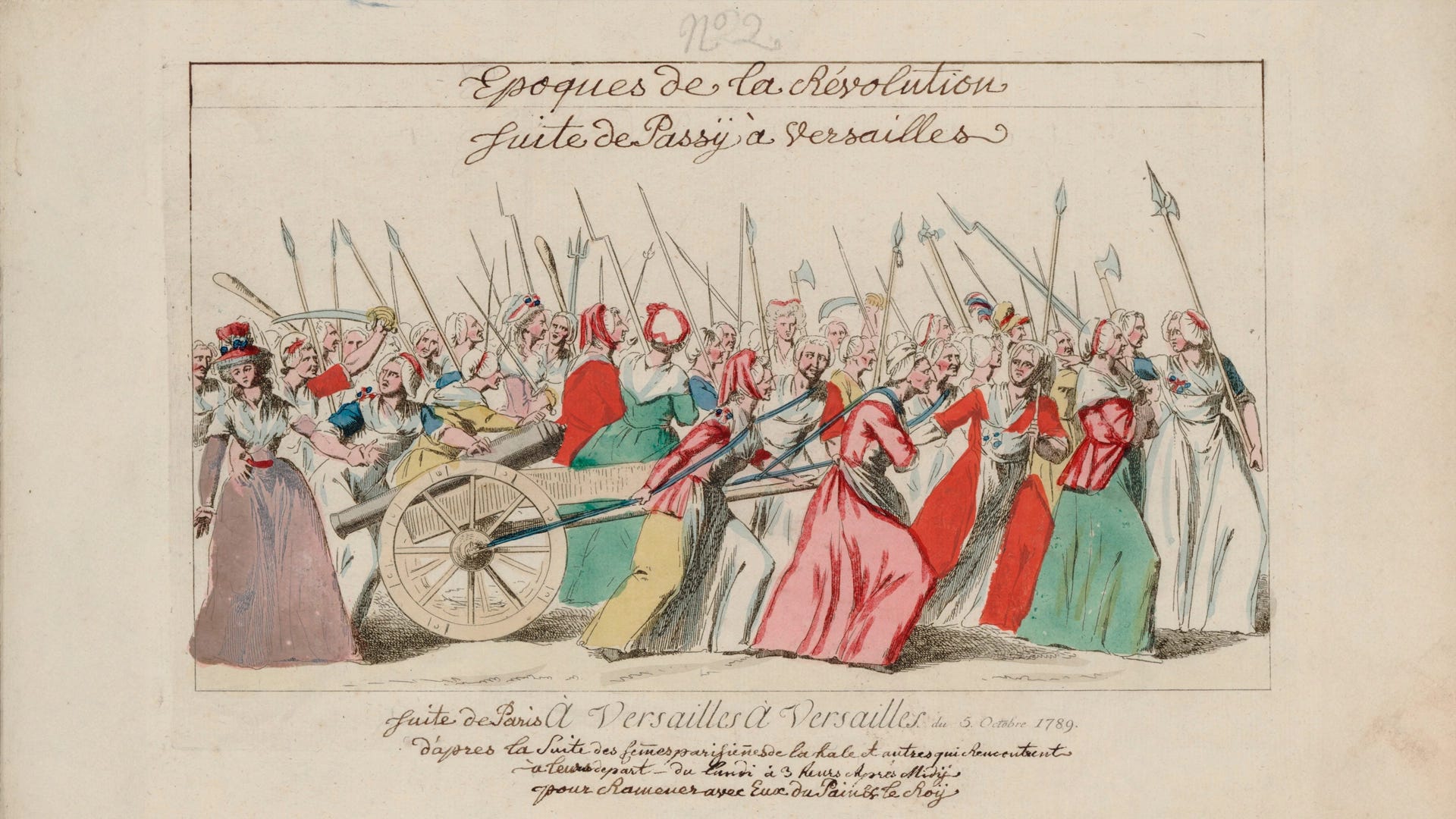
Women forced under starvation of family and violent inner feeling take to the streets of Versailles in hopes of capturing bread., a contemporary illustration of the Women’s March on Versailles. Art credit: Unknown author – This file comes from Gallica Digital Library and is available under the digital ID btv1b8410839z/f1, Wikimedia Commons, Public Domain.

Hunger has a funny way of concentrating the attention.
The cost of food and cutbacks in the provision of food for those who need it have been drivers of mass protest throughout much of history:
One of the events initiating the French Revolution was the Women’s March on Versailles which began among women in the marketplaces of Paris protesting the high price and scarcity of bread. Their demonstrations quickly became intertwined with the activities of those who were seeking an end to autocracy and had just issued the Declaration of the Rights of Man.
The 2008 Egyptian general strike over rising food costs provided inspiration for the overthrow of Egyptian dictator Hosni Mubarak three years later.
In 2022 in Sri Lanka, rising food prices among other grievances led to protests that culminated in the overthrow of the ruling regime.
Recent months have seen the emergence of a powerful movement-based opposition to Trump and MAGA, manifested in the seven million participants in No Kings Day and the unprecedented on-the-ground opposition to ICE and National Guard occupations of American cities. At the same time, the price of food for Americans of every class has soared: a survey this summer by the Associated Press and NORC found the cost of groceries has become a major source of stress for just over half of all Americans — outpacing rent, health care, and student debt.
What are sometimes belittled as “pocketbook issues” like the cost of food, housing, and medical care have become critical issues for a majority of Americans. So far, the hundreds of millions suffering from inflated prices have not found a way to organize themselves and fight back. Nor has the movement-based opposition taken up their cause. But a rarely remembered consumer boycott half-a-century ago indicates how such self-organization against high food prices might emerge.
“America’s Largest Protest”
(8 Apr 1973) “Boycot Meat” protesters in New York demand cut down on weapons expenditure and roll back on food prices. Video credit: AP Archive
Ann Giordano, 33 described herself as “just a housewife.” She recalled that she was never particularly conscious of food prices; her Staten Island kitchen didn’t have enough shelf space for her to buy in large quantities. But one day when she had put the groceries away there was still space left on the shelf. She vaguely wondered if she had left a bag of food at the store. Next time she came home from shopping, she looked in her wallet and concluded that she had accidentally left a $20 bill behind. When she went back to the supermarket and found out how much her food really cost, she suddenly realized where the shelf space had come from and where the money had gone.
It was early spring in 1973. Inflation was rising, food prices were soaring, and millions of shoppers nationwide were having similar experiences. Mrs. Giordano called some of her friends and discussed the idea of a consumer boycott – an idea that was springing up simultaneously in many places around the country in response to rising food prices. Soon a substantial network of women was calling homes all over Staten Island, spreading word of the boycott. They called a meeting at a local bowling alley to which over one hundred people came on two days’ notice. They named themselves JET-STOP (Joint Effort to Stop These Outrageous Prices) and elected captains for each district. Within a week they had covered the Island with leaflets. picketed the major stores, and laid the basis for a highly effective boycott.
Mrs. Giordano and her friends were typical of those who gave birth to the 1973 consumer meat boycott, “a movement which started in a hundred different places all at once and that’s not led by anyone.” As a newspaper account described it,
“The boycott is being organized principally at the grassroots level rather than by any overall committee or national leadership. It is made up mainly of groups of tenants in apartment buildings, neighbors who shop at the same markets in small towns, block associations, and-perhaps most typical-groups of women who meet every morning over coffee. All have been spurred into action by the common desire to bring food prices back to what they consider a manageable level.”
The 1973 consumer meat boycott was undoubtedly the largest mass protest in American history. A Gallup poll taken at the end of the boycott found that over 25 percent of all consumers– representing families with fifty million members–had participated in it. Large retail and wholesale distributors reported their meat sales down by one-half to two-thirds. The boycott was strongest among what the press referred to as “middle income” families- those with incomes around the then-national average of $10,000 to $12,000 a year. It represented, in the words of one reporter, “an awareness that, for a whole new class of Americans like themselves, push has finally come to shove.”
In low-income neighborhoods, sales fell less during the boycott, largely because, as retailers pointed out, the residents, who couldn’t afford much meat at any time, had been cutting back for weeks due to high prices. As one Harlem merchant said, “How much can these people tighten their belts when they don’t have too much under their belts in the first place?”
Some advocates of the boycott made the dubious argument that it would bring meat prices down by reducing the demand for meat. Most participants, however, saw the movement as a protest, a way of communicating to politicians and others what they felt about the rising cost of living.
President Nixon responded by putting a freeze on meat prices, but his move was met by scorn among many boycotters, who felt that prices were already far too high (“They locked the barn door after the cow went through the roof,” commented one housewife).
“We Ain’t Buying It!”

Visit: https://weaintbuyingit.com/
The meat boycott did not prove to be an effective tactic for combating high prices. Lacking a further strategy for meeting its participants’ needs and failing to hook up with the other mass insurgencies of the time, the movement soon lost momentum. Participants stopped coordinating their activity and returned to more individual strategies. But it did show the tremendous capacity of ordinary people to organize themselves on a massive national scale around issues of mutual concern – in this case the price of food.
Recent months have seen the emergence of the consumer boycott as a powerful vehicle for combatting the Trump regime and undermining its “pillars of support.” Today’s boycotts are far more effectively targeted on specific institutions and realizable demands. For example, when the “Tesla takedown” challenged Elon Musk’s role demolishing federal agencies and jobs, sales plunged and company stocks fell 13% in three months. A boycott campaign against Target initiated in January by the local Black community in Minneapolis over its reversal of its DEI policies has now cut sharply into its sales, helping lead to its stock falling 33%, a $20 billion loss in shareholder value, and replacement of its CEO. When Disney took late-night host Jimmy Kimmel off the air over comments he made following the murder of Charlie Kirk in September, the Working Families Party helped put together a toolkit that explained how to cancel a Disney subscription. The Wall Street Journal reported that customers ditched Disney+ and Hulu at double the normal rates in September. Disney brought Kimmel back within days and Hulu soon followed suit.
Today’s boycotts are also much better aligned with other forces. For example, in the days following Thanksgiving, major organizations that had backed the millions-strong national No Kings and MayDay2025 days of action, including Indivisible, 50501, and MayDayStrong, swung behind the boycotts of Target, Amazon, Home Depot, and other major corporations. Some national coordination was provided by a group that called itself “We Ain’t Buying It.”
This action is taking direct aim at Target, for caving to this administration’s biased attacks on DEI; Home Depot, for allowing and colluding with ICE to kidnap our neighbors on their properties; and Amazon, for funding this administration to secure their own corporate tax cuts.
These groups and many others are backing the boycott in support of striking Starbuck’s workers under the slogan, “No contract, no coffee!”
Like the Tesla Takedowns, these boycotts are coordinated with and often spearheaded by demonstrations and other forms of direct action at physical locations. And they are finding ways to stimulate other forms of pressure on their targets: The Amazon protest group Athenaforall, for example, is encouraging local groups to demand an end to local contracts with Amazon, permission for Amazon expansions, and public subsidies for Amazon.
Today’s boycott actions are better targeted and better allied than the 1973 meat boycott, but so far, they have not drawn in much of the population that is directly harmed by Trump and his corporate backers. The 1973 meat boycott shows that pocketbook issues, such as inflation and most notably food prices, can be a basis for self-organization and action beyond the electoral arena among the wide swath of people they affect.
The 1973 meat boycott illustrates the way what are sometimes dismissed as “pocketbook issues” can be drivers of self-organization and massive outpourings of public discontent. Such examples from the past are unlikely to provide us the specific programs or tactics we need to meet today’s food crises. But they do demonstrate the power that people can mobilize when they are driven by food deprivation.
The next Strike! Commentary will spell out how today’s discontented consumers might converge with the movement-based opposition to Trumpian autocracy.
Thanks for your analysis. Will Restack.